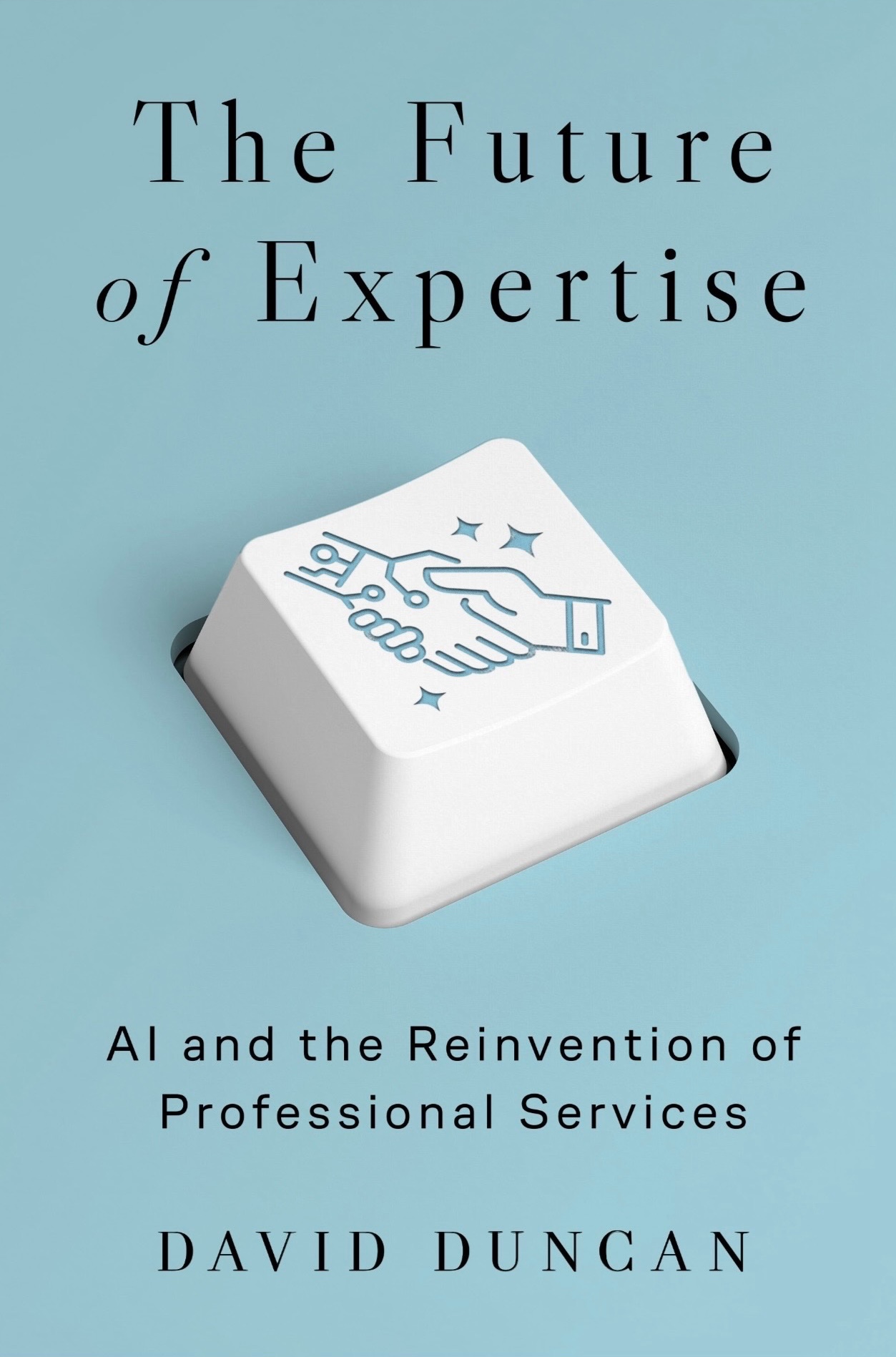
Coming June 2027 · Harvard Business Review Press
The Future of Expertise
AI and the Reinvention of Professional Services
If machines can now think, what is an expert for? What happens to everyone who has built a business or career on expertise when it stops being scarce?
For centuries, machines have amplified physical labor. Over the past fifty years, digital technologies extended this pattern to the collection, organization, and processing of information. Now, for the first time, we have a technology capable of automating thinking itself.
If you spend your career thinking for a living, what made you valuable is changing. And if you lead an organization of such people, every assumption your business rests on is now open to question.
The services model AI is disrupting has existed for around a hundred years. Consulting, law, accounting and engineering firms hire talented, ambitious people, train them through years of ever more challenging work, and sell their collective thinking to clients needing expertise they don't possess in-house. The model, known as the pyramid, has been phenomenally successful.
AI is now putting pressure on every part of it at once, with its force concentrated most on the foundational layer of junior professionals, whose work AI is displacing. It's this layer that drives much of a firm's profits, and is where the next generation of partners comes from.
“You described my life. What do I do now?”
An experienced manager at a big firm, responding to the article that became this book
Firms are already responding, and with an increasing sense of urgency. They've announced investments in AI to the tune of billions of dollars, rolled out the latest tools across their workforces, and partnered with AI-powered specialists. These are real commitments, but they don't signal a redesign of the architecture of expertise itself, or the role that humans play in it.
This book is about that redesign.
Inside the book
Overview of the book
-
Part I
The Age of the Pyramids
Examines how the modern professions are built, an essential foundation for diagnosing both what AI threatens to dismantle and what must be preserved. It starts with what clients actually buy when they hire a professional services firm. From there, it describes how the pyramid model was engineered, the tenets that allowed it to work so brilliantly for so long, and how AI is now straining every one of them.
-
Part II
The New Shape of Expertise
Focuses on what comes next. It describes the new tenets of the emerging model and works through the implications for competitive advantage, how firms will develop talent when the traditional apprenticeship breaks down, and how the role of leaders must evolve.
-
Part III
The New Playbooks
Examines what this all means for different stakeholders: how incumbents transform, how clients buy smarter, how these same pressures are impacting corporate functions such as strategy, finance, legal, or internal consulting groups, and how early and mid-career professionals navigate what comes next.
Who it's for
This book is for anyone who has hard-won expertise and is trying to make sense of what AI means for their careers and organizations
Leaders of professional firms will find a framework for understanding the disruption and a roadmap for responding to it.
Early and mid-career professionals will find a way to understand what AI means for their careers and how to interpret the changes unfolding, as well as a view of which skills will matter and how to acquire them.
Those working inside expertise-oriented functions in companies, in strategy, legal, finance, R&D, and beyond will gain an understanding of how AI is likely to affect their function and role, guidance on using it to reshape their own area, and advice for helping their broader organization drive AI transformation.
Clients who buy expertise will find guidance for assessing what kind of professional services are still worth paying for, how to tell what firms are best situated to deliver them, and how to pay for outcomes instead of hours.
Students and those about to enter the professions, whether from a university, law school, or business school, will find an up to date description of the firms they’re entering and what skills will matter.